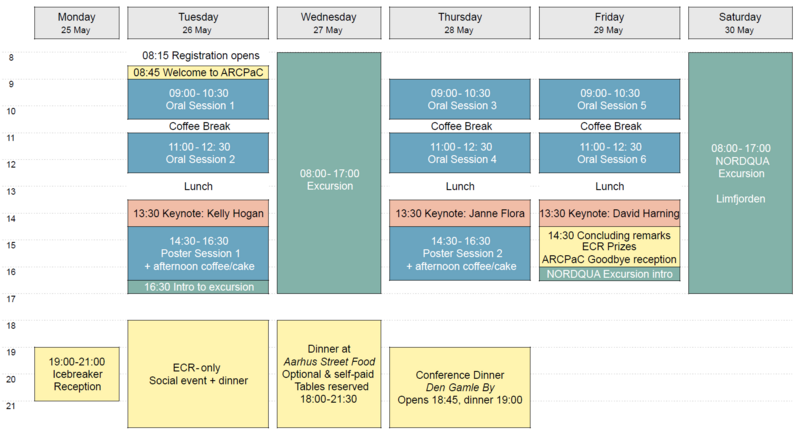
Browse the individual sessions below by expanding the sections, or download the overview of session and full book of abstracts as a single pdf here.
09:00 | Joanna Davies | Atmospheric warming drove breakup of the Last Glacial Maximum Northeast Greenland ice shelf |
09:15 | David Roberts | Holocene environmental change at the grounding line of the Northeast Greenland ice stream |
09:30 | Holly Jenkins | A palaeo-reconstruction of 20th century ice shelf dynamics in northeast Greenland, through epishelf lake sediments |
09:45 | Clara Lery | New constraints on Late-glacial and Holocene ice-margin fluctuations in Scoresby Sund (Kangertittivaq), East-Central Greenland |
10:00 | Shannon Klotsko | A Massive Grounded Ice Shelf in Baffin Bay Buttressed the Greenland, Laurentide, and Innuitian Ice Sheets During the Last Glacial Maximum |
10:15 | Anna Bang Kvorning | From Ice Shelf to Open Water: Holocene Cryosphere and Ecosystem Change in Melville Bay, NW Greenland |
11:00 | Darrell Kaufman | Holocene glacier expansions based on radiocarbon-dated ancient plants at retreating ice margins, Brooks Range, Arctic Alaska |
11:15 | Aleksandra Osika | Holocene glacial history of southern Spitsbergen: known knowns and known unknowns |
11:30 | Kristian Svennevig | Recent and past tsunamigenic landslides in Greenland and what they tell us about the impact of climate change |
11:45 | Ívar Örn Benediktsson | The age and formation of the Skessugarður blocky end moraine, east Iceland |
12:00 | Henrik Rasmussen | Storegga tsunami run-up reconstruction from the outer coast of Troms, northern Norway, including a 10 m surprise find |
12:15 | Katrine Juul Andresen | Buried glacial landscapes in Kalø Bay, south-western Kattegat, Denmark |
09:00 | Jochen Knies | Antarctification of Greenland ice sheet following the Mid Pleistocene Transition |
09:15 | Chris Larson | Meteoric beryllium-10 in Camp Century subglacial sediment suggests the ice sheet was absent from NW Greenland for at least 8000 years during MIS 11 |
09:30 | Caroline Brand | Quantifying Quaternary Glacial Sediment Deposits Associated with Erosion by the Greenland Ice Sheet |
09:45 | Frances Butcher | A new 25-stage reconstruction of the flow pattern evolution of the Scandinavian Ice Sheet based on the subglacial lineation record. |
10:00 | Lasse Tésik Prins | Last Glacial Maximum ice extent in the western Danish North Sea – landscape development and glacial tectonics |
10:15 | Walter Geibert | Freshwater in the glacial Arctic Ocean – the evolution of findings in the last five years |
11:00 | Henning A. Bauch | Subsurface Injections of Warm Atlantic Waters into the Subarctic North Atlantic During Major Deglaciations |
11:15 | Giulia Amaglio | Tracing Arctic Atlantification from the Little Ice Age to the present day in the Barents and Fram Strait: insights from biomarkers |
11:30 | Anne de Vernal | Palynological records from the Southern Lomonosov Ridge document late Pleistocene to Holocene paleoclimates in the eastern Arctic |
11:45 | Laura Bronzo | A 24-kyr multiproxy record of ocean-ice interactions off western Svalbard: insights from phytoplankton communities |
12:00 | Mahima Pai | A Multi-Proxy Approach to Reconstructing Glaciomarine and Oceanographic Change in Hornsund, Svalbard |
12:15 | Christoph Vogt | Central Arctic Ocean sediment records: Carbonate minerals, the importance of detrital, diagenetic, authigenic and biogenic origin |
09:00 | Kasia Śliwińska | Defining states and variability of the terrestrial cryosphere of the Greenland Ice Sheet by marine-ice core integration: Past-to-Future (P2F) project contribution |
09:15 | Lindsey Monito | Reconstructing Timing of western Greenland Ice Sheet Dynamics at the Last Deglacial Using Paleomagnetic Secular Variation |
09:30 | Sami Cargill | Regional Paleomagnetic-Lithostratigraphic Framework for the Last 50kyr in Northeast Baffin Bay |
09:45 | Megh Kanvinde | Extending the central Arctic “Globigerina” exumbilicata (Turborotalita egelida) biohorizon to the North Atlantic |
10:00 | Mohammad Javad (Mehrdad) Razmjooei | Reassessing Radiocarbon Chronologies in Arctic Ocean Sediments Using Calcareous Nannofossil Bioevents |
10:15 | Robert Spielhagen | Arctic Ocean surface sediment ages, sedimentation rates and the impacts of bioturbation and bottom currents |
11:00 | Lucy Roberts | Environmental and habitat controls on non-marine ostracod distribution in Arctic lakes |
11:15 | Caroline Planche | Early Holocene vegetation and environmental responses to abrupt climate variability in the Icelandic highlands |
11:30 | Inda Brinkmann | Sedimentary ancient DNA records climate change and permafrost thaw effects on Arctic coastal ecosystems in the Mackenzie Delta, Canada |
11:45 | Andreas Duus Petersen | Flooding of glacial paleolandscapes - high-resolution mapping of erosion and deposition processes in the eastern North Sea |
12:00 | Sarah Ferrandin | Environmental controls on organic carbon sequestration on the Northeast Greenland shelf since deglaciation |
12:15 | Subhadip Mukherjee | A High-Resolution Ichnological Approach to Arctic Palaeoenvironmental Reconstruction |
All 59 poster presentations will be organized into two main sessions, but are here listed in alphabetical order
| Aisling O'Brien | The Abundance of Diatoms in Sediments from the Greenland Sea |
| Alessandro Sartini | Paleo-ecological impact of meltwater events on the Arctic marine ecosystem: a study of changes in biodiversity and biogeochemistry in the Fram Strait: some preliminary analysis |
| Alice Carter-Champion | Linking Fram Strait marine sediment cores using tephrostratigraphy: a pilot study spanning the Last Glacial-Interglacial Transition |
| Amalie Krogholm Arildslund | Holocene variability of Atlantic Water inflow to Narsaq Sound, Southwest Greenland, reconstructed from benthic foraminifera |
| Amy McGuire | Towards a pan-Arctic marine tephrostratigraphy |
| Andreas Duus Petersen | Flooding of glacial paleolandscapes - high-resolution mapping of erosion and deposition processes in the eastern North Sea |
| Anna Hughes | Ice streams of the Eurasian Ice Sheet Complex |
| Anna Pieńkowski | Late-summer ice-edge productivity recorded by extreme diatom biomarker enrichment in the Barents Sea |
| Aylin de Campo | Cosmogenic chlorine-36 constraints on Holocene glacier change in Iceland |
| Brendan Reilly | Plio-Pleistocene Magnetostratigraphy of Eastern Fram Strait Drifts (IODP Exp. 403) |
| Caixia Dong | Asynchronous sea-ice responses driven by Atlantic Water inflow over the past 14,600 years, Svalbard |
| Carl Regnéll | Northern Swedish rivers – carved by glacial floods |
| Christine Tømmervik Kollsgård | Moraines in the southern Norwegian North Sea |
| Cuong Ngo | Refining Arctic Plant Diversity Dynamics |
| Eleonora Santucci | Late Holocene Sea-Ice Variability and Water-Mass Dynamics in Edisto Inlet (Antarctica): A High-Resolution Multi-Proxy Approach for Bipolar Comparisons |
| Erin Gregory | Dynamic post-LGM ice sheet retreat after loss of ice shelf buttress in Melville Bugt, west Greenland |
| Frances Butcher | A candidate subglacial palaeolake basin associated with regionally widespread eskers and debris-covered glaciers on Mars |
| Gregor Luetzenburg | Re-evaluating Holocene relative sea-level change in central western Greenland using remote sensing geomorphology |
| Henrieka Detlef | Holocene sea-ice and ecosystem dynamics north of Greenland – from the Arctic’s Last Ice Area to the North Water Polynya |
| Jakob Hamann | The geomorphic signature of Late Weichselian ice shelves and deglacial dynamics along the Isfjorden Coast, Svalbard |
| Jakob Reif | Asynchronous glacial response during the Younger Dryas in Troms, Norway, influenced by internal ice-sheet dynamics and local topographic controls |
| Jesper Nørgaard | Dating DK: Cosmogenic 10Be depth profiling of glacial outwash plains in Denmark |
| Jingyuan Zhang | Diagenetic Overprint and Magnetostratigraphic Fidelity in Central Arctic Ocean Sediments |
| Joachim Jepsen | Size variability of the centric diatom Coscinodiscus centralis in northern Baffin Bay throughout the Holocene |
| Jonas Damsgård | Estimating fjord sediment volumes and subglacial erosion rates in Greenland from fjord morphology |
| Joseph Licciardi | Fennoscandian Ice Sheet and Baltic Ice Lake Connections to Abrupt Global Climate Changes During the Last Deglaciation |
| Joshua Williams | An Ancient Giant Post-Glacial Landslide Hidden in a Danish Tunnel Valley |
| Julia Garcia-Oteyza Ciria | Multiproxy Perspectives on Glacial Oscillations and Climate Variability in Northeast Greenland |
| Katherine Stelling | Evidence for a dynamic marine-terminating western margin of the Greenland Ice Sheet during Marine Isotope Stage 3 |
| Keito Aonuma | Changes in Water Dynamics of the Arctic Ocean: Insights from ²²⁶Ra during the 2024 Polarstern PS144 Cruise |
| Kristaps Lamsters | Glacial geomorphology of palaeo-ice lobe beds in Latvia |
| Kwangkyu Park | Refining Quaternary chronostratigraphy in the western Arctic Ocean using multiproxy sediment records |
| Lara Pérez | Northeast Greenland Glaciated Margin: an IODP3 Proposal |
| Lara Pérez | Understanding Greenlandic landslide risk in a warming climate |
| Lena Anders | Exploring Arctic Ocean Conditions Beyond the Last Interglacial Period: A Multi-Proxy Approach |
| Letizia Roscelli | Holocene environmental evolution in Tuktoyaktuk Harbor revealed by organic biomarkers |
| Maciej Telesiński | The 6.8 ka BP event in the Nordic Seas and its worldwide impacts |
| Maija Heikkilä | Reconstructing Holocene algal biodiversity in a high-latitude lake with sedimentary ancient DNA and pigments |
| Marie Winther | Previously unrecognized giant paleo-landslides in Denmark: towards a national inventory |
| Mathia Sabino | Frozen Archives: Reconstructing Ancient Greenland Ecosystems and Environments from Basal Ice |
| Matthew Hunt | Deglacial Retreat of the palaeo-Kangerlussuaq Ice Stream, South-East Greenland |
| Maureen Walczak | The Role of the Pacific Ocean and Adjacent Crysophere in Past Abrupt Climate Oscillations |
| Meri Mäkelä | Dinoflagellate cyst as indicators of sea-ice conditions: Implications of machine learning techniques and regional surface sediment dataset |
| Monika Mikler | The geochemical and paleoenvironmental significance of the enhanced biosynthesis of a tri-unsaturated highly branched isoprenoid during late Heinrich Stadial 1 in Baffin Bay |
| Paulina Romel | Early postglacial paleoceanography of the western Canadian Arctic Archipelago: preliminary multiproxy evidence from the Beaufort Sea and M’Clure Strait |
| Petra Hus | Preliminary Results of High-Resolution Micropaleontological Analysis in Rijpfjorden, Northern Svalbard |
| Ricardo D. Monedero-Contreras | Greenland Ice Sheet dynamics and weathering regimes during past warm intervals: Evidence from micro-CT analysis of ice-rafted debris |
| Robyn Granger | Water mass changes in North Greenland fjords during the Holocene |
| Rujian Wang | Size-dependent 𝛿¹⁸O and 𝛿¹³C variations in a planktic foraminiferal Neogloboquadrina pachyderma (sinistral) record from Chukchi Plateau: implications for (sub)surface water conditions in the western Arctic Ocean over the past ~50 ka |
| Sine Kirstine Kabel | Flooding of tidal estuaries – A study from the central Danish North Sea |
| Stine Detjens | Mapping the Drowned North – Legacy Data Perspectives on the Eastern Sector of Doggerland |
| Tine L. Rasmussen | Deep water exchange through the western Fram Strait during marine isotope stages (MIS) 10 to 1, last 345 ka |
| Tjördis Störling | Greenland Ice Sheet responses to past warm climate intervals: Provenance insights from North-East Baffin Bay |
| Tommaso Tesi | Using long-chain diols to resolve input of nutrients and river-derived carbon to the Arctic Ocean |
| Vårin Trælvik Eilertsen | Iverryggen – Hill-hole pair on the Norwegian continental shelf odd Mid-Norway |
| Wenshen Xiao | Surface sediment composition off northern Greenland |
| Wesley Farnsworth | The Nordic Palaeo Alliance (NORPALL) – a NordForsk Network for Early Career Quaternary Researchers |
| Xiaotong Xiao | Ice sheet - ocean interaction in the central Canadian Arctic Archipelago area during the final deglacial-Holocene transition |
We are very excited to be able to present the following three keynote speakers. Click on the names below to expand and see a short bio for each speaker.
Tuesday 13:30 - 14:30, convener: Anna Hughes
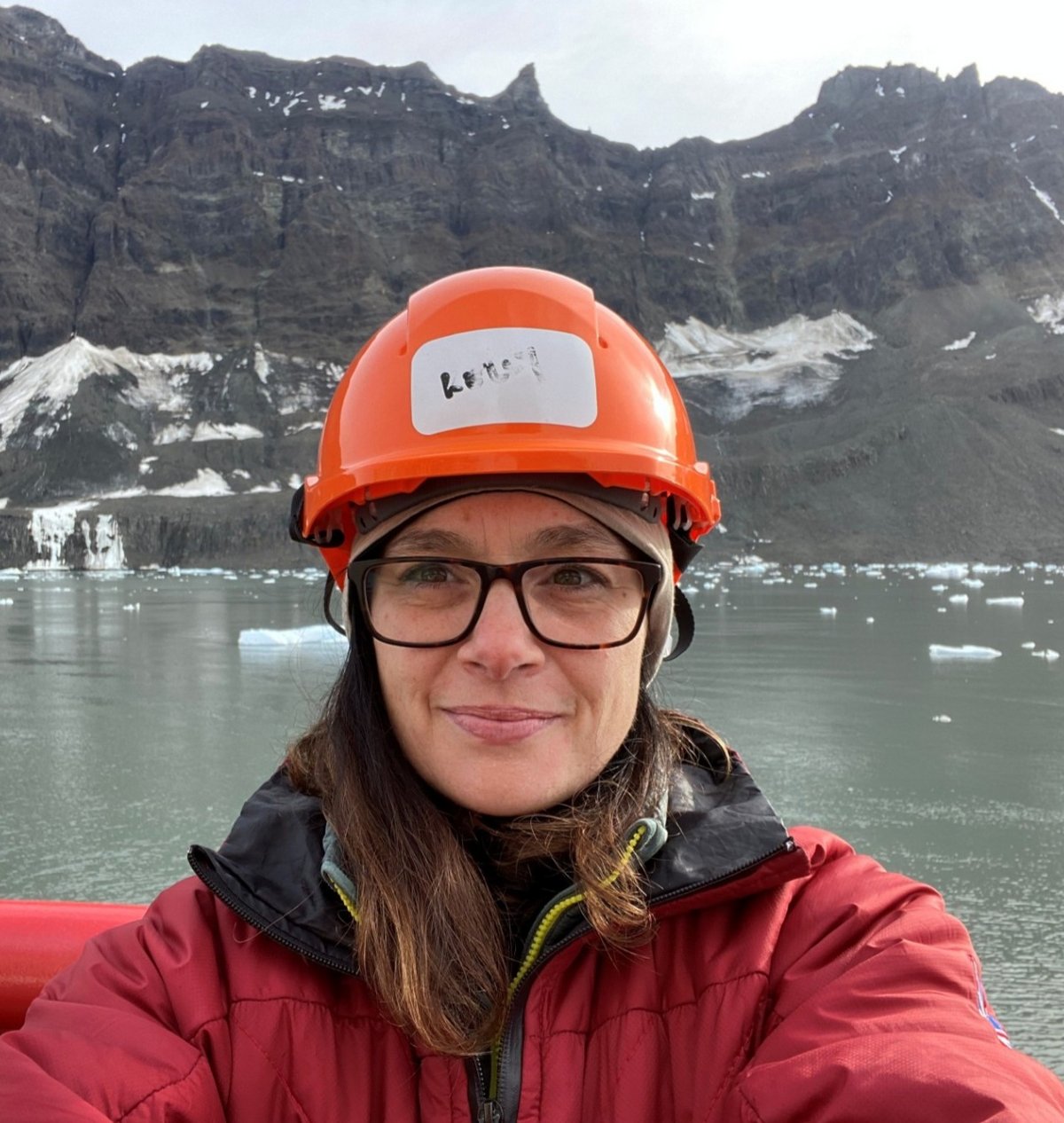
Kelly Hogan is a Marine Geophysicist at the British Antarctic Survey, based in Cambridge in the UK. She received her PhD from the Scott Polar Research Institute, University of Cambridge, and is currently the PI of two projects in Greenland investigating ocean-forced glacier retreat, funded by UK funding agencies, NERC and ARIA. Her personal research focuses on reconstructing the flow and retreat patterns of past ice sheets from seafloor landforms and sediments but she enjoys collaborating with remote-sensors, glaciologists, numerical modellers and oceanographers to study ice sheets in a holistic and multidisciplinary way. Although working in both Polar Regions, in the Arctic she has extensive experience working in fjords around Svalbard, and studying glacier retreat from East, West and Northwest Greenland.
Thursday 13:30 - 14:30, convener: Henrieka Detlef
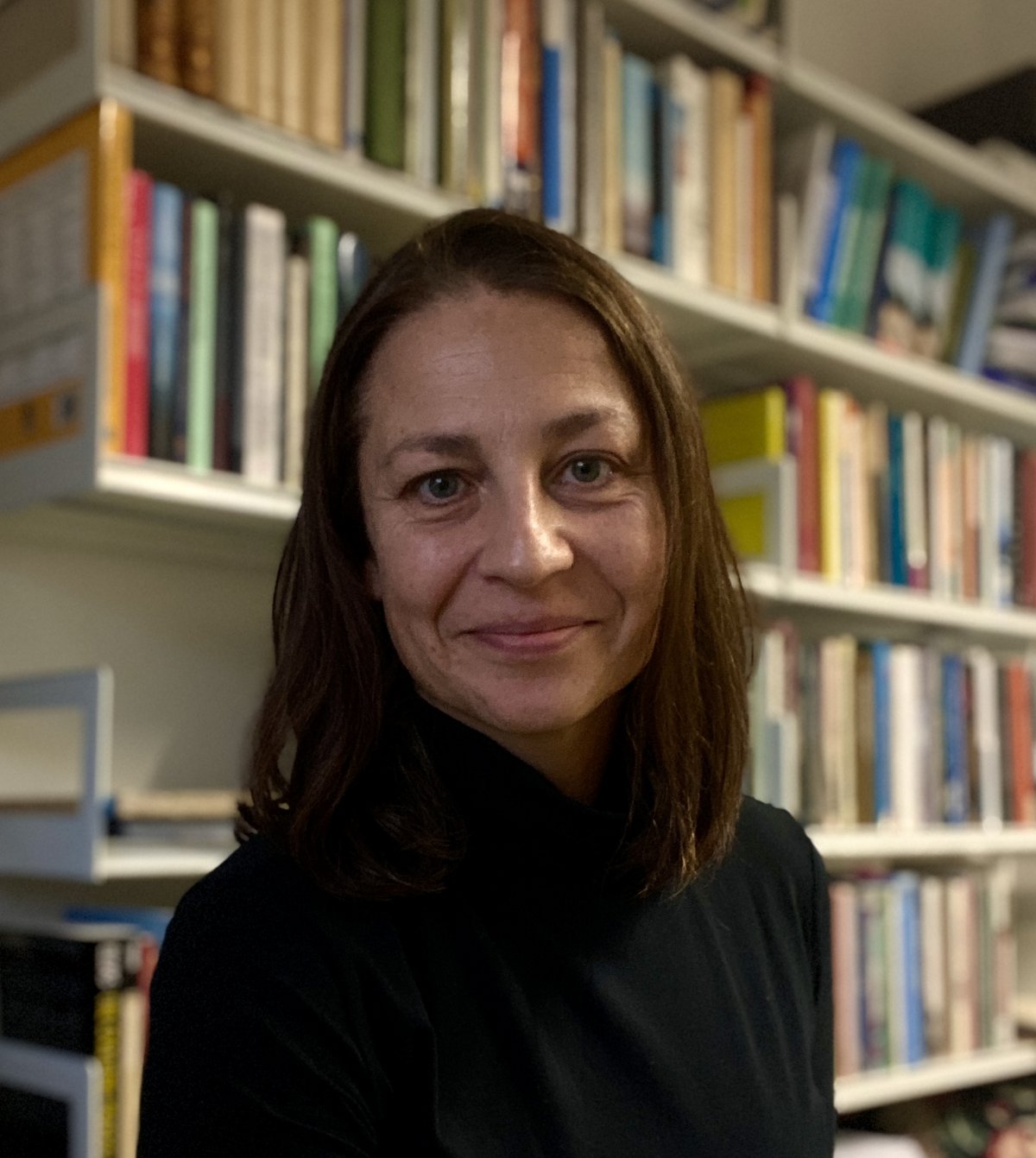
Janne Flora is Associate Professor at the Department of Anthropology, Aarhus University, and Centre Leader of AUNA: AU Centre for North Atlantic and Arctic Research. She received her PhD from the Scott Polar Research Institute, University of Cambridge, and is PI of Hunting Life: Explorations in Biosociality in Greenland (Carlsberg Foundation). Her research focuses on human–environment relations and questions of sustainability in hunting communities, particularly in East and Northwest Greenland. She has extensive experience collaborating with Greenlandic hunters and across disciplines, and is especially interested in how different forms of expertise meet. Her work explores how knowledge is produced, negotiated, and sometimes contested; both between scientists and local communities, and across the boundaries of the natural and social sciences.
Friday 13:30 - 14:30, convener: Jochen Knies
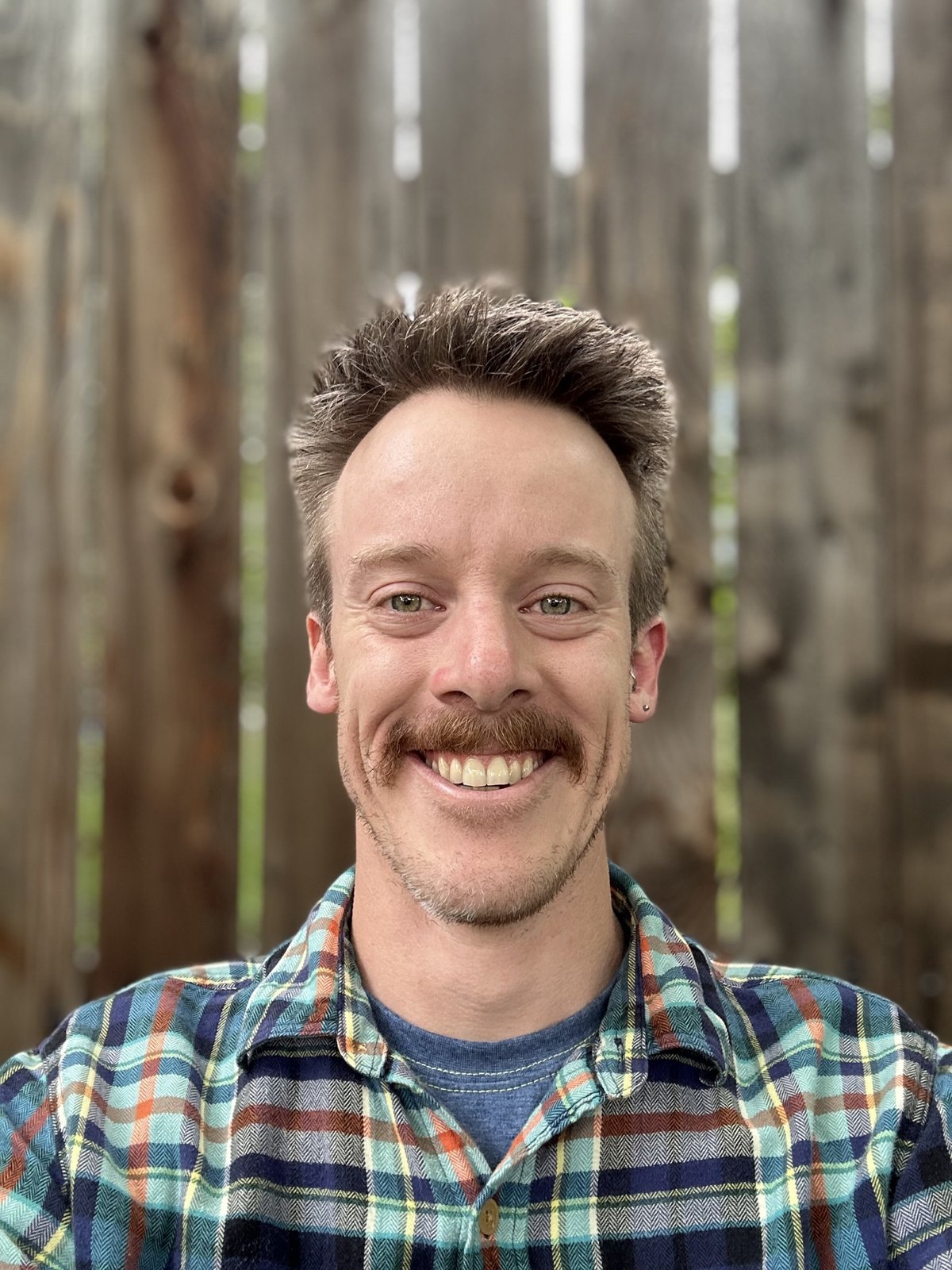
David Harning is a Research Scientist at the University of Colorado Boulder and affiliate with NOAA's NCEI World Data Service for Paleoclimatology. He received his PhD jointly from the University of Iceland and University of Colorado Boulder. His research currently focuses on how Holocene climate impacts glaciers, shrubs, and carbon cycling in lake and marine environments, with an emphasis on Iceland. To do so, he develops and uses geochemical tools based on lipids, stable isotopes, and ancient DNA, and incorporates new geochronological, data science, and modeling approaches.
On Wednesday, we will go to the Djursland peninsula and visit several sites with interesting glacial geology. Buses will take us to the localities which are about 45 minutes driving northeast from central Aarhus. The excursion is led by Timothy Lane, Anders Damsgaard, and Jan Piotrowski.
More information on the NORDQUA Excursion in this document.
Register here. We have space for 40 participants only. Once filled up, all following registrations will be directed to a waiting list.
Follow NORDQUA's homepage for more information.